
Garry Reeves and his wife Kathy Reeves run a home-based honey operation in Moores Hill.
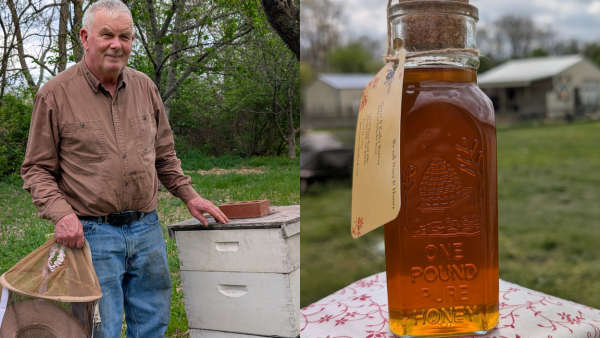
Garry Reeves. Photo by Cheryl Damon-Greiner.
If you drive past the Reeves property with the big HONEY sign at the end of their driveway on a warm morning, chances are you might hear the hum before you see anything at all. That steady sound, if you could hear it, comes from over a million honeybees and from a kind of work that is slowly becoming rarer, harder, and more important with every passing year.
Garry Reeves and his wife Kathy Reeves run a home-based honey operation in Moores Hill that’s as much about perseverance as it is about sweetness. Garry didn’t start out thinking he’d become a full-fledged beekeeper. Like a lot of folks here, he grew up watching his dad keep a few hives mostly for family and friends. Back in the 1960s and 70s, beekeeping was simpler. Everything was done by hand, and there always seemed to be honeycomb, wax and all, in a jar on the kitchen table. Garry and his siblings would scoop it out with a spoon, swirl it into peanut butter, and spread it on bread for lunch.
Garry officially started keeping his own bees around 2007, while also working construction jobs alongside his father. But by then, the world of bees had changed dramatically. In the late 1980s and early 1990s, a tiny parasite called the Varroa destructor mite swept across the country from overseas. It didn’t just weaken colonies—it nearly wiped out wild honey bees altogether and started destroying managed hives. These mites attach to adult bees and developing brood, draining them and spreading viruses that can collapse an entire hive in just a few seasons. For beekeepers, what was once a hands-off practice has become a constant fight for survival. In 2009 Garry started the Southeastern Indiana Beekeepers Association to bring beekeepers together who share a common desire to raise healthy honeybees. Dozens of interested people come to the monthly SIBA meetings held on the 3rd Thursday of the month at 6:30pm at 412 Eastern Ave, Sunman, IN 47041.
Today, Garry manages close to 200 hives, starting his days around 7:30 in the morning and often working until dark. The job is physical and relentless: He does hive inspections and swarm control to prevent loss of bees, uses integrated pest management to treat infestations without harming the colony, lifts heavy brood boxes, paints and weatherproofs, and repairs equipment. In spring and summer, he may add frames to prevent overcrowding, manage queen cells, and prepare for honey harvests. In winter, he focuses on insulation, food stores, and hive stability. When honey is ready (at least two-thirds of frames capped with wax), he extracts it, uncapping, and spinning it with centrifugal extractors. Then he strains, bottles and labels the honey. He maintains detailed logs of hive health, harvest weights, and seasonal trends to guide future management. At day’s end, he cleans extraction equipment, organizes supplies, and plans the next day’s work, often adapting to weather and bee activity
Beekeepers have had to become part farmer, part mechanic and part veterinarian just to keep colonies alive. Treatments to control mites are costly, time-consuming, and unavoidable. Without them, most hives won’t last more than a year or two. And there are new breeds of mites on the horizon as well as murderous hornets that can kill entire colonies of bees.
Bees also face environmental threats from lawn and agricultural pesticides, the loss of flowering plants and trees, and changing weather patterns that can throw off bloom times. On top of that, between a quarter and half of all U.S. honey bees die every year, forcing keepers like Garry to continually rebuild their colonies. It’s no wonder that about 80 percent of new beekeepers quit within their first two years. The romantic idea of tending bees doesn’t always survive the reality of expense, frustration, and hard physical work.
So why keep going? Ask Garry, and the answer is personal and generational. It’s the smell of a hive filled with brood, wax, pollen, and nectar. It’s the taste of honey straight from the comb—unfiltered, still warm. It’s the sound of a thriving colony, a steady, reassuring rhythm. Beekeeping is sticky, heavy, painful at times, expensive and deeply rewarding all at once.
Beyond the personal rewards, there’s a much bigger reason Garry’s work matters to the rest of us. Honey bees play a crucial role in pollinating many of the foods we rely on—apples, cherries, blueberries, cucumbers, broccoli, herbs, and watermelons to name just a few. Every February, millions of colonies from the Midwest are trucked across the country to pollinate California almond orchards and Florida orange groves. Without bees, food wouldn’t disappear entirely, but it would become more expensive, less diverse, and far less local.
Of course, we can see the benefits of bees right in our own kitchens—through honey. Raw, locally produced honey has long been valued not only for its flavor but also for its health benefits. Many people use it to soothe sore throats, support digestion, or help manage seasonal sniffles. Honey also has natural antibacterial properties and has been used for centuries as a gentle remedy for minor wounds and burns. While it’s not a cure-all, it’s a reminder that something so simple and nature-made can be deeply nourishing.
Supporting the work of local beekeepers means more than buying a jar of their honey at Farmers Markets, a Local Section at the grocery, or roadside stands, though that is certainly important. It means providing plants for pollination in your own backyard and letting your garden be a little more freeform instead of spraying chemicals. In a time when so many small, hands-on traditions are disappearing, local hives of bees are still buzzing thanks to the beekeepers. And as long as they are, our gardens, fields, orchards, and tables are richer for it.
 Gov. Braun Directs Statewide Storm Recovery, Activates Emergency Funds for Impacted Hoosiers
 Dearborn Co. Traffic Safety Partnership to Increase Impaired Driving Enforcement Ahead of Labor Day
 PAWS Of Dearborn County Needs You - Right Now
 Fall Music Fest Lineup Unveiled
 Water Main Break Impacting Hoosier Hills Water Customers
 Maxwell: Indiana Senate Republicans Offering Paid Spring Internships