The college opened in 1856.
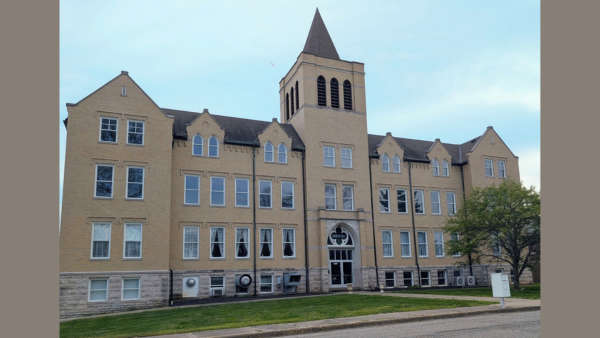
Carnegie Hall. Photo by Cheryl Damon-Greiner.
In the early years of our country, before college campuses stretched across large cities, education arrived in Moores Hill by wagon, by foot, and by faith. In the middle of the 19th century, schooling in much of Indiana was still considered a private affair, something reserved for those who could afford tutors or church instruction. Yet in this small southeastern Indiana village, neighbors came together around a shared conviction: learning mattered, and it should be close to home.
The seed was planted in 1853, when the Rev. W. W. Snyder visited Moores Hill to raise funds for Brookville College. Though his mission lay elsewhere, his visit stirred something deeper in local merchant and landowner John C. Moore. Why, Moore wondered, should young people have to leave their community to pursue higher learning? After conversations with A. L. Osgood of the Baltimore and Ohio Railroad and other town leaders, a meeting was called at the Methodist Church on December 20. By evening’s end, articles of association were signed and $3,000 pledged—no small sum for a rural village.
Just weeks later, on January 10, 1854, the State of Indiana granted a charter for the Moores Hill Male and Female Collegiate Institute. From the beginning, the name reflected the school’s progressive spirit. At a time when few Indiana colleges admitted women, the citizens of Moores Hill insisted that education should be open to both sons and daughters. Land was donated, trustees were named, and bricks were made locally, molded by hand from nearby clay.
When the college opened on September 9, 1856, about 150 students enrolled. The village quickly changed. Teachers moved in, students filled boardinghouses, and conversation turned to lessons, lectures, and examinations. Moore himself welcomed students into his own home, providing lodging without charge to those who had nowhere else to stay. Education was no longer an idea—it was now a daily presence, woven into the life of the town.
The Civil War cast a long shadow over Moores Hill. In 1861, students and townsmen alike enlisted, and the college’s first president, the Rev. S. R. Adams, left to serve as a chaplain with the Indiana Volunteers. Faculty leadership shifted repeatedly as instructors joined the war effort. At one point, Mrs. Adams herself stepped forward to keep the college doors open. Even as uncertainty reigned, the commitment to learning endured.
Through the 1800s, the college quietly built its reputation. It became known as one of only two institutions in Indiana to admit women, celebrating its first female graduate, Jane S. Churchill, as early as 1858. In 1887, the school was renamed Moores Hill College, and in 1890 it added a department for the training of teachers, an expansion that would impact classrooms across the region for generations.
Growth brought both pride and pressure. By the early 1900s, Moore’s Hall, the original campus building, could no longer meet the needs of a growing student body. Under the leadership of President Frank Clare English, the college took an ambitious step, appealing to industrialist Andrew Carnegie for assistance.
Carnegie, already known for supporting libraries and schools nationwide, agreed to fund half the cost of a new building. His gift of $18,750 helped make the new college building possible. The cornerstone was laid on June 12, 1907, and on June 18, 1908, Carnegie Hall was dedicated. Moore’s Hall, once the sole building, became a student dormitory.
Yet the college never escaped financial strain. Endowment campaigns fell short, and the burden grew heavier with each passing year. Then, in November 1915, tragedy struck. A fire destroyed the student dormitory in Moore’s Hall. With no money to rebuild, trustees made the painful decision to move the college to Evansville. In 1917, Moores Hill College departed the town that had given it life, later becoming the University of Evansville.
Carnegie Hall, however, remained open. In the years that followed, the building found new purpose as part of the Dearborn County public school system. As one-room schoolhouses closed, young students from across the area passed through its doors. For decades, Carnegie Hall remained a place where lessons were learned and memories made, until school consolidation in the county brought that chapter to a close in 1978.
After years of being unoccupied, demolition seemed imminent. But once again, the community responded. Former students and local citizens formed the Carnegie Historic Landmarks Preservation Society in 1995, determined to save the building that had given so much. Their efforts succeeded. Listed on the National Register of Historic Places, Carnegie Hall now serves as a museum, event space, and community center—a quiet witness to more than a century of learning.
Today, Carnegie Hall stands proudly as it always has, reminding Moores Hill residents and visitors alike of a time when neighbors believed deeply in education and acted boldly to support it. Brick by brick, lesson by lesson, the town built more than a school. It built a legacy—and that legacy still stands.
 Aurora Man Identified as Victim of Fatal Motorcycle Crash
 Dearborn County Recycling Center’s Costume Swap Open for 17th Year
 Rep. Zimmerman: Governor Answers Lawmakers' Call to Provide Diesel Fuel Relief for Farmers
 State Sen. Maxwell: Protecting Hoosier Communities
 South Ripley Sweeps Aurora Farmers Fair King & Queen Contest
 St. Leon Site at I-74 Selected for Duke Energy Site Readiness Program