Our series on local towns and cities continues.
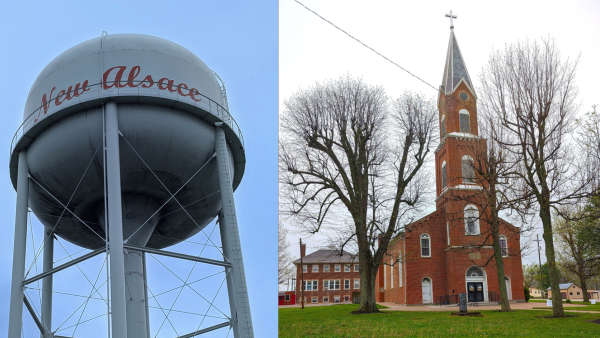
Water tower in New Alsace and St Paul Church, now called All Saints Church. Photos by Cheryl Damon-Greiner.
If you’ve ever taken the back roads in Dearborn County and spotted a tall Gothic-style church rising above a handful of plain buildings, you’ve probably found New Alsace. It’s tiny and charming not because anyone planned it that way, but because the place grew up around a close-knit immigrant community and then simply kept its small-town scale. Today you’ll find St. Paul’s/All Saints Catholic Church, a former tavern, an American Legion Post, a park, a handful of businesses, a water tower, schools, and homes. The post office closed in 1904. But behind that short list is a long history that stretches from Europe’s upheavals to Indiana’s frontier years.
New Alsace was built in the 1830s by German-speaking immigrants from Alsace, a region on the borderlands of France and Germany. For many, Cincinnati was a stop along the way before they moved into southeastern Indiana, where they established a settlement that had their roots right in the name: New Alsace. The first settler was a Frenchman named Anthony Walliezer in 1833. He was followed by George Voglegesang, a native of Bavaria who started a blacksmith business, followed by John Decker, a grocer and James Cannon, a dry goods salesman. In 1840, John Kesler became postmaster.
Like so many American immigrant stories, this one starts with push and pull. The “pull” was straightforward: land was available, small industries were thriving, and the promise of a church and school made a new settlement feel more like a real home than a gamble. The “push” came from the tremors that shook Europe in the late 1700s and early 1800s. Many Alsatians were among those who fled during the French Revolution’s Reign of Terror, when more than 17,000 people were executed and another 10,000 died in prison. Considering the deep political changes that were happening, it’s not hard to see why immigration from Alsace increased in the early 19th century.
New Alsace was founded as a Catholic community, and its early history can’t really be separated from St. Paul’s. The congregation was organized in 1833 by Rev. Joseph Ferneding, a pioneering German Catholic priest. By August 1834, the church in New Alsace—dedicated under the title of St. Paul—along with the rectory, had been completed, and Father Ferneding had been joined by his sister. In those frontier days, finishing a church and rectory that quickly was a statement that the community intended to stay.
St. Paul’s became important well beyond the town limits. It served congregations in both southeastern Indiana and Cincinnati. New Alsace became the ‘mother church’ of the Whitewater area chiefly because the Germans—who outnumbered the English-speaking Catholics—were located there. For many families it was the place where baptisms happened, marriages were blessed, and funerals were held. New Alsace began with Alsatian roots, but other German immigrants settled there too. It’s a reminder that immigrant communities were rarely one single thread. They were more like braided rope: related languages, familiar customs, and shared church life tying people together as the town took shape.
One day violence and upheaval came to New Alsace. On July 13, 1863, during the Civil War, Confederate General John Hunt Morgan and his Raiders entered town as Mass was being held at St Paul's, continuing their rampage across southern Indiana. They stole the horses that were tied outside the church and ransacked the widow Margaretha Yaeger’s store who had recently lost her only son at the Battle of Vicksburg. Morgan set up headquarters at Blettner’s Tavern (today known as Klump’s Tavern), and reportedly took a four-hour nap next store at Gephard’s Tavern. Two hours after the Raiders left, Union horsemen arrived, hot on their trail, and pursued them to the Whitewater River.
By the 1860s, New Alsace had grown to around 600 people in town, with St. Paul’s serving more than a thousand members from New Alsace and the surrounding countryside. Before Prohibition, the town even supported two breweries and fourteen taverns. That might sound surprising for a small community until you remember its German heritage, where brewing was both a craft and a social glue. Because of its location on the way to and from Cincinnati, many weary travelers passed through New Alsace and stopped for food and drinks.
Immigration from Alsace didn’t stop with the first wave. It continued for years and became a classic example of chain migration: early settlers wrote back, encouraged relatives and friends, and helped them make the jump. Newcomers were drawn by practical things—available land, business opportunities, and the reassurance of church and school life already in place. Just as important, the movement of people away from New Alsace was comparatively small. Once families put down roots, they had good reason to stay.
That steadiness is part of what makes New Alsace such a fitting place to think about big anniversaries like our country’s 250th birthday. The story here isn’t about famous founders or grand buildings. It’s about everyday people who crossed an ocean because life back home had become frightening and uncertain, then built a community sturdy enough to hold onto. Residents retained the Alsace folklore and habits, and the everyday culture remained strongly German. But once in Indiana, that heritage added aspects that were still familiar, but shaped by American land, neighbors, and events (including a Confederate raid right in the middle of Mass).
So if you drive through New Alsace today and it feels like time slows down, that’s not your imagination—it’s the result of a place that never needed to be big to be important. The Gothic-style church still anchors the town. The taverns still stand, but are closed. The cemetery still quietly lists where people came from, one stone at a time, and it shares its sacred grounds with later residents who called this part of Indiana home.
In a nation that’s spent 250 years growing, moving, and reinventing itself, New Alsace offers a small but meaningful reminder: Sometimes history is written in a church registry, a family letter inviting someone to come, and a little town whose name combines memories of their founders’ past with the brave life they created here – New Alsace.
 Aurora Man Identified as Victim of Fatal Motorcycle Crash
 Dearborn County Recycling Center’s Costume Swap Open for 17th Year
 Rep. Zimmerman: Governor Answers Lawmakers' Call to Provide Diesel Fuel Relief for Farmers
 State Sen. Maxwell: Protecting Hoosier Communities
 UPDATE: Downtown Lawrenceburg Road Paving Schedule Announced
 South Ripley Sweeps Aurora Farmers Fair King & Queen Contest