The third in a series of stories highlighting area towns.
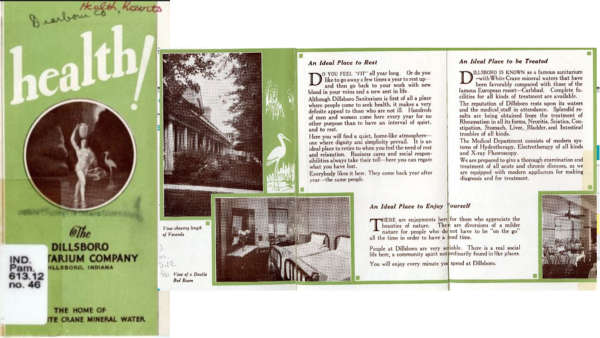
Photos via Indiana State Library.
(Dillsboro, Ind.) - The Trenton Gas Field, in East Central Indiana, was discovered in 1876. The enormity of the field was not known until the 1880s when it turned out to be the largest natural gas discovery in the United States up to that time. The field also contained the first large oil reserve discovered in the United States, with an estimated 1 billion barrels of oil. This discovery led to the Indiana Gas Boom. Which led to a group of speculators, about 20 years later, who started drilling for oil in Dillsboro. Before cars were commonplace, oil was used mainly for lighting and heat throughout the country and Dillsboro was ready to cash in. But instead of oil, they discovered an underground spring of mineral water – pristine, black, and very smelly mineral water. The health remedy of choice - the more unpleasant the better - mineral water was touted by every newspaper and magazine of the time. Even rural news readers knew that the elite in Europe enjoyed the healing virtues of mineral springs and that, with proper promotion, the elite would find their way to Dillsboro. And so the Dillsboro Health Sanitarium was born with private rooms, catered meals, tranquil setting, and baths and sips of nature’s own ‘healing’ water.
By the 1910s, the accidental discovery had transformed the town into a destination. The mineral water was quickly promoted as medicinal, and the Dillsboro Sanitarium rose to meet demand. Advertisements proudly declared the town “The Home of the White Crane Mineral Water,” promising relief for rheumatism, digestive ailments, and the exhaustion of modern life. What visitors encountered was not gentle spring water. The baths were fed by sulphur-rich mineral water—black, pungent, and unmistakable. In the early 1900’s, unpleasantness was not a flaw. It was proof that it worked. Guests, seeking renewed health, came from Indiana, Kentucky, and Ohio, many from Cincinnati, to soak, drink, and stay for weeks at a time (this is where the economic benefit to Dillsboro hinged).
In those days, Dillsboro had two identities. For residents, the town was a place of routine and responsibility. For visitors, it was a place deliberately set apart from ordinary life. Most mornings in Dillsboro began early. Long before the sanitarium’s guests rose for their first baths, townspeople were already awake—stoking stoves, tending animals, feeding the kids, opening shops, or preparing to head out to nearby farms. Homes were modest, often without electricity or indoor plumbing. Water came from wells. Heat came from coal or wood. Meals were made from what could be grown, preserved, or purchased locally. Church services, general stores, and school events formed the center of social life. Even during the height of the spa years, Dillsboro remained a working town. The presence of visitors changed the economy, but not the rhythm of daily life for most who lived there.
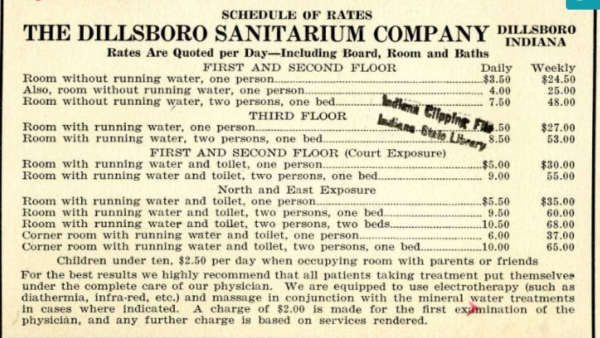
Photo via Indiana State Library.
For those arriving at the Dillsboro Sanitarium, the town offered something entirely different. Visitors came in horse-drawn wagons, and some in cars, seeking relief—from illness, from exhaustion, from the pace of city life. Many stayed for weeks, sometimes longer, following scheduled routines that slowed the day rather than filled it. Time at the spa was measured not by productivity, but by treatments: baths, rest periods, walks, and carefully prepared meals. Physical labor was discouraged. Rest itself was considered medicine. The most demanding task of the day might be enduring the sulphur baths.
Local residents worked at the sanitarium as cooks, attendants, cleaners, and laborers. Farmers supplied food. Shopkeepers benefited from the steady flow of guests. The spa brought money and opportunity into town, and many families relied on it. While visitors rested, residents worked. While one group sought recovery, the other managed the daily chores that made that recovery possible.
This coexistence worked as long as belief in the mineral springs cures remained. But the passing years brought automobiles that expanded travel options and doctors’ offices with prescription and over-the-counter remedies. Even highway 50 was changed to pass Dillsboro rather than go through it. Visitors stopped coming. The sanitarium closed. For residents, life continued—leaner, quieter, but familiar. The town had existed before the spa, and it endured after it. What disappeared was not the mineral water beneath Dillsboro, but the idea that it could transform daily life.
Is the water still there? There aren’t any modern records that indicate that Dillsboro’s mineral water ran dry or was destroyed. Geological studies show that southern Indiana continues to sit on top of active groundwater systems, and there is no evidence the original source was depleted. What changed was usage. Today, Dillsboro’s drinking water comes from a different, regulated aquifer through Aurora Utilities. The historic mineral water remains out of sight and unused, not gone.
As our country marks 250 years, Dillsboro’s story offers a reminder that history is not only written in capitals, but in small towns shaped by chance. Dillsboro did not become a spa town by design. It became one because drillers missed their target and struck something else instead. For decades, that accident sustained a community and placed it briefly on the map of American health tourism. Indiana’s story is full of such moments: places that rose not because plans succeeded, but because Hoosiers adapted with a Plan B.
 Kentuckians Warned of Continued Text Message Scam Posing as State Agency
 GoFundMe Nearing Fundraising Goal for Injured Lawrenceburg Teen
 Applications Available for Hughes Scholarship
 Dillsboro, Friendship Fire Departments Battle Brush Fire
 Birthday Cards Requested for Local World War II Veteran
 East Central FFA Compete at District 12 Leadership Contest