You can find the historic plaque on the levee behind Ivy Tech.
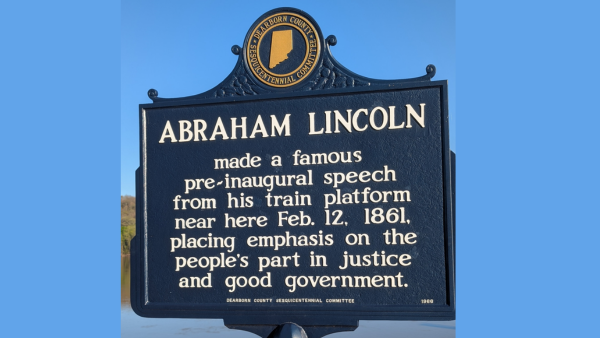
Historic plaque in Lawrenceburg. Photo by Cheryl Damon-Greiner.
A few blocks from the railroad tracks that cut through Lawrenceburg’s riverside neighborhoods, a historic plaque commemorates a brief but meaningful chapter in local history. It was a cold February morning in 1861 when president-elect Abraham Lincoln’s decorated train slowed for a whistle stop here on February 12. The plaque records his two-minute speech emphasizing the people’s role in justice and good government.
It does not mention that the country was already coming apart. By the time Lincoln left Springfield, Illinois, bound for Washington, D.C., seven Southern states had seceded from the Union, and others threatened to follow. He was traveling east to take the oath of office at a moment when democracy itself seemed in danger. Lincoln’s pre-inaugural journey lasted thirteen days—long enough for history to pass through dozens of towns, including Lawrenceburg, before reaching the nation’s capital.
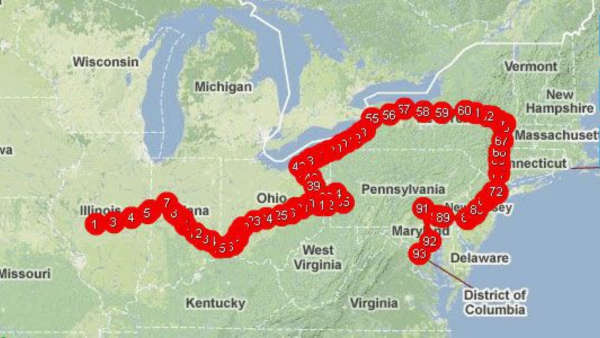
Map of Lincoln's inaugural train trip - from Emergingcivilwar.com
Lincoln’s journey on the private 3-car train with his wife and sons was marked by sharp contrasts. In major cities along the route, large receptions were staged, complete with formal welcomes, grand speeches, and cheering crowds pressing in for a glimpse of the nation’s next leader. The whistle stops, however, were another matter entirely.
Lincoln’s stop in Lawrenceburg came near the end of two days crossing Indiana by rail. After festive events in Indianapolis where he delivered one of his first major addresses as president-elect, his train resumed its eastward course the following morning, his fifty-second birthday. It slowed at Shelbyville, Greensburg, and Morris before reaching Lawrenceburg and continuing on into Ohio.
In towns like Lawrenceburg, the train halted only briefly. There was no elaborate stage, no time for long speeches. A modest crowd gathered along the tracks anyway. Farmers, shopkeepers, laborers, and families came to see the man whose image and words were already becoming familiar through newspapers and campaign posters. For those present, it was a once-in-a-lifetime moment: history passing through their town in a cloud of steam. Despite the uncertainty of the times, there were no street protests. Before social media and modern communications, political differences were argued in newspaper editorials, party meetings, and private conversations in taverns and churches.
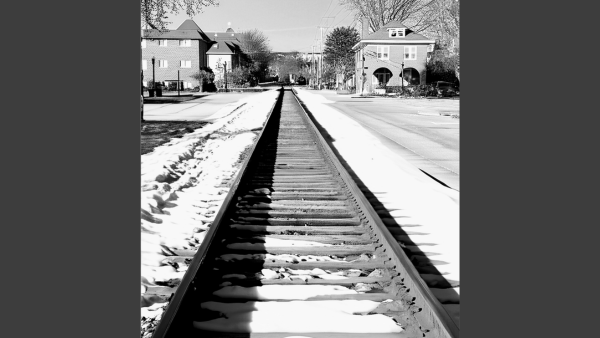
Railroad tracks in Lawrenceburg near the river. Photo by Cheryl Damon-Greiner.
For Lincoln, Indiana held particular meaning. Though Illinois was his adopted home, Indiana had shaped him. He had spent his youth here, from age seven to twenty-one, laboring on the frontier, reading by firelight, and learning hard lessons. These brief Indiana stops connected him to his Hoosier roots at a moment when he was reflecting deeply on the road that had brought him this far and on the uncertain road ahead. There were credible fears Lincoln might never reach Washington alive, and he had been informed of the danger.
Rumors of assassination followed the train east. The most serious threat centered on Baltimore, a city known for election-day riots and strong Southern sympathies. Intelligence suggested that secessionist activists and sympathetic railroad workers planned to attack Lincoln as he changed trains in the city. The plot involved creating a public disturbance to draw police away, then striking quickly before Lincoln could board the next train. A getaway boat was even prepared.
Alarmed by these reports, railroad president Samuel M. Felton hired detective Allan Pinkerton to investigate and safeguard Lincoln’s passage. No federal protective service yet existed, and the danger was real enough that security was tightened, and secrecy increasingly replaced ceremony. Stops were shortened and carefully controlled.
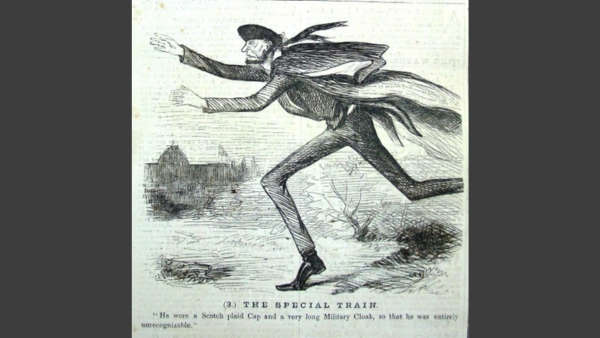
Newspaper cartoon 1861 - from Emergingcivilwar.com
Among the investigators was a woman whose role history nearly forgot. Kate Warne, the first female detective employed by the Pinkerton Agency worked undercover by infiltrating secessionists rallies as a wealthy Southern matron. She gathered critical information about the Baltimore conspiracy, confirming that an organized effort was underway to assassinate Lincoln before he could take office. Her findings forced decisive and controversial action. Against his own instincts and with great reluctance, Lincoln agreed to alter his travel plans. Disguised as an invalid with Warne as his nurse, and traveling under cover of darkness, he passed through Baltimore earlier than scheduled, avoiding the waiting assassins. With Detective Allen Pinkerton accompanying him, Lincoln boarded a special train headed back to Philadelphia, where he connected with an unmarked 11 p.m. train to the nation's capital. Telegraph lines out of the city were cut to prevent word about the trip from spreading. The plot to kill him failed, and Lincoln’s life was spared. Mary Lincoln and the rest of the Lincoln party continued to Baltimore, then on to Washington. Incredibly, Lincoln was mocked and ridiculed in the press for “sneaking” into Washington DC.
None of that drama was visible in Lawrenceburg. To those watching from the platform, Lincoln appeared calm and approachable beneath his tall top hat. He offered brief remarks, his voice slightly hoarse as it carried through winter air and locomotive steam. He acknowledged the crowd, encouraged civic participation, and moved on. The moment was fleeting, but its significance has endured. That brief whistle stop linked a small Hoosier river town to the man raised in Indiana who would soon lead the nation through its most profound crisis.
Within weeks of that visit, Lincoln would stand on the steps of the Capitol to deliver his first inaugural address, calling for unity and appealing to “the better angels of our nature.” Within months, the country would be at war. The whistle stop in Lawrenceburg was not marked by big displays; it is a reminder that history doesn’t always unfold with spectacle. Sometimes it is created during brief stops in small communities before pressing forward into uncertain times, sustained by the hope that those better angels will prevail.
 Fourth Annual Ivy Tech Day Set for April 21
 Rising Sun Regional Foundation Awards $168K in New Grants
 Stoneking Named Batesville High School Principal
 Green Alert Cancelled for Burlington Man
 Indiana Governor Declares Gas Tax Holiday to Save Money for Hoosier
 Tommy Palmer Announces Candidacy for Dearborn County Council – District 2