How a 1960s resort concept grew into one of Dearborn County’s most unusual modern communities.
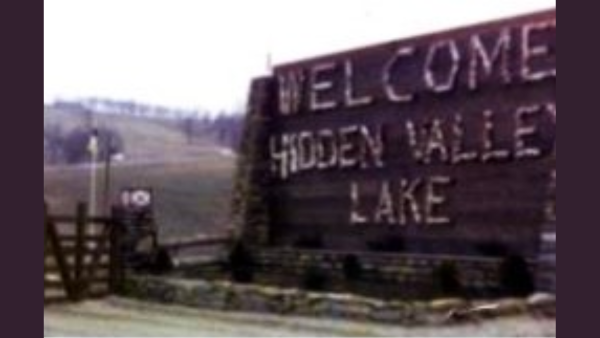
Original Hidden Valley Lake sign.
(Lawrenceburg, Ind.) - For generations, Southeast Indiana’s communities grew the traditional way — along rivers, railroads and courthouse squares. Towns like Lawrenceburg, Aurora and Greendale took shape over centuries, built slowly by farmers, merchants and industry that helped define Dearborn County’s history. Hidden Valley Lake was different. Tucked near the Indiana-Ohio border, it rose from wooded hillsides in little more than half a century, transforming from an ambitious vacation concept into a full-fledged hometown.
Hidden Valley Lake was never meant to be a town.
It began as a bold recreational escape where families could boat, golf, swim and enjoy a mountain-style atmosphere without leaving the Midwest. In 1969, developer James J. Rupel of Dayton, Ohio bought more than 1,200 acres along State Line Road, later expanding the project to more than 2,400 acres. For southeast Indiana at the time, the vision was unusually ambitious — especially given that the land had once been considered as a possible landfill site.
Instead, Rupel and his team remade the valley into one of Indiana’s most unusual residential developments. Construction began in 1970, with Hidden Valley Drive — still known locally as “the front hill” — becoming the first road cut through the steep, wooded landscape. At the center of the project was a 150-acre lake created by what was then the largest earthen dam in Indiana. Work on the 150-foot-high dam began in 1971 and ended in 1973, and the lake reached full pool in 1974. Today, it stretches across 4.5 miles of shoreline and reaches depths of nearly 120 feet.
Even before the lake was full, buyers were snapping up lots on speculation, betting that something special was taking shape in the hills.
Many of them never left. What began as a second-home getaway gradually became a full-time community, especially as interstate development expanded and suburban growth from Cincinnati pushed outward, making Hidden Valley an attractive option for commuters seeking lake living with easy access to the city.
The first home in Hidden Valley was built by Gilbert Edger and Helen Edger on Overlook Circle. Early residents such as Cindy Miller, owner of the subdivision’s second home ever built, helped establish the traditions and neighborly culture that longtime residents say still define the community.
Today, Hidden Valley includes about 1,800 homes and nearly 5,000 residents. Though privately governed, it functions in many ways like a small town, with its own utility systems, maintenance departments and deputy staff working alongside the Dearborn County Sheriff’s Department. The Hidden Valley Lake Property Owners Association, formed in 1972, oversees much of that infrastructure through an elected board that resembles a town council.
Its amenities rival those of many small towns and resort communities.
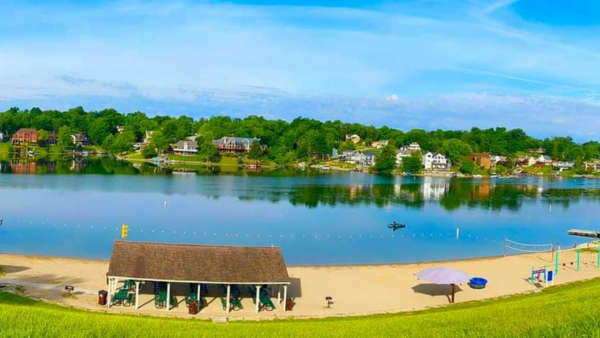
Beach and shelter at Hidden Valley Lake.
Residents have access to a golf course, marinas, beaches, a swimming pool, tennis and pickleball courts, hiking trails, playgrounds, athletic fields, picnic shelters and a fitness center. In summer, the lake becomes the community’s front porch, drawing boaters, anglers, skiers, kayakers and swimmers to the
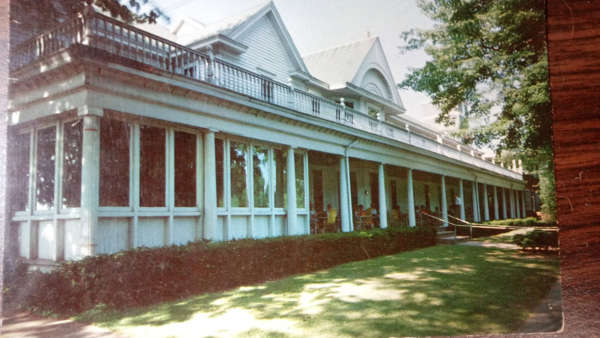
water. Landmarks such as the Chalet — now Willie’s Restaurant — became gathering places for generations, while the golf course expanded from nine holes to 18 as the community grew.
For all its growth, residents say Hidden Valley has held on to the spirit that first drew people there more than five decades ago. On warm summer afternoons, neighbors still tie boats together for floating parties. Community groups organize charity drives and fundraisers, and traditions such as Fourth of July celebrations, Labor Day festivities and the annual Polar Bear Dip continue to pull residents together. Even the community’s honorary “mayor” reflects a culture built as much on fun and connection as on governance.
Like many established towns, Hidden Valley also faces the challenges that come with age.
Aging infrastructure — including ongoing multimillion-dollar water system upgrades — has fueled debates over transparency, priorities and how best to maintain a community largely built in the 1970s. Longtime residents say those growing pains are simply part of the next chapter for a place that is no longer new, but fully grown.
In that sense, Hidden Valley represents something rare in southeast Indiana history: proof that entirely new communities can still be built. Most Dearborn County towns trace their origins to the 1800s. Hidden Valley Lake does not. It started as a vacation dream and, in just over 50 years, became home.
 Whiskey City’s Liberty Theater Wins State Restoration Prize
 Minor Injuries in Small Aircraft Crash in Jefferson County
 Local, Regional Officials Hold Groundbreaking for Copper Creek Apartments in Greendale
 First Responders Respond to Water Rescue Call
 P.A.W.S. Rummage Sale: Find Hidden Gems & Help Furry Friends
 10th Annual Dillsboro Heritage Days Kicks Off This Weekend