For a brief time, West Harrison had one of the most unusual attractions in southeastern Indiana.
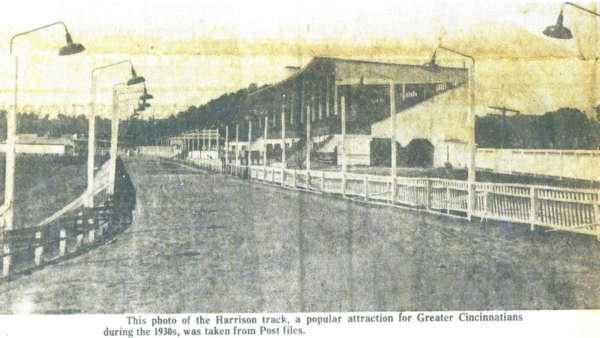
Old newspaper photo from the Cincinnati Post.
(West Harrison, Ind.) - Most people driving north out of West Harrison on Old U.S. 52 probably pass the open field across from Whitewater Motors without giving it much thought. But nearly a century ago, that same field was one of the busiest and most unusual places in the area.
In the 1930s, this was the site of the Harrison Kennel Club - a greyhound racing track about twenty miles from downtown Cincinnati. The track was known as the Harrison Kennel Club, using the name “Harrison” likely because visitors from Cincinnati were more familiar with nearby Harrison, Ohio, than with West Harrison, Indiana.
On race nights it was an easy drive for people looking for an evening of excitement. The once quiet area came alive with the rumble of traffic, thousands of cheering spectators, and the sound of dogs chasing a mechanical rabbit around the track.
The track opened at a time when greyhound racing was becoming popular across the country. Cincinnati-area promoters had been involved with dog racing in Ohio, but after legal trouble there, they looked just across the Indiana line for a new location. West Harrison, sitting along U.S. 52, now Harrison-Brookville Road, was a convenient spot. In a matter of weeks what had been a cornfield was turned into a racing facility with a grandstand, ticket booths, and the equipment, stalls, and oval track needed to run the dogs.
A Depression-Era Boost for Town
For West Harrison, the Harrison Kennel Club was more than entertainment. This was the Great Depression, and the track brought much-needed work and business to town. Restaurants, taverns, gas stations, hotels, meat markets, farmers, and local workers all benefited when the crowds came in. Farmers earned extra money boarding greyhounds and trainers. Meat markets sold scraps to feed the dogs. Young men worked at the track as “Lead-Out Boys,” walking the greyhounds before races, loading them into the starting boxes, retrieving them afterward, and cooling them down.
Local memories still preserve some of those names, including Ham Rolfes, Eugene and Alfie Rolfes, Carl Lehman, Bill Warburg, and John Viel. The McElroy brothers operated the mechanical rabbit that the dogs chased around the oval. Local historians have estimated that the track employed around 100 people and supported nearly every merchant in town. For a small community during hard times, that was no small thing.
The Monkey Jockeys
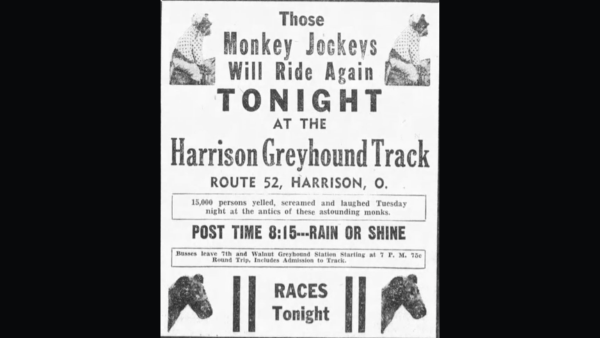
One of the most talked-about attractions at the Harrison Kennel Club was something that sounds almost unbelievable today: monkey jockey races. Small monkeys, dressed in colorful silk jockey uniforms, rode strapped to the backs of racing dogs. The idea had started in Florida and spread to tracks around the country, but for people in this area, West Harrison was the place to see it. Older residents later remembered cars backing up for miles along U.S. 52, sometimes almost reaching Miamitown, as crowds made their way to the track.
The track offered more than racing. There were bands, beauty contests, sideshows, and special events meant to keep people coming back. Several newspaper accounts from 1936 even reported that Olympic track star Jesse Owens raced a greyhound there and won by a step. Whether people came for the races, the entertainment, the novelty, or just a night out, the Harrison Kennel Club gave the area something to talk about.
Excitement and Controversy
Of course, all that excitement came with controversy. Gambling was a constant issue, and Indiana authorities repeatedly challenged the betting that went along with the races. Court injunctions temporarily stopped wagering, while the track’s owners argued that the racing itself was legal. Rumors also grew over the years about outside interests, organized crime, and pressure from competitors in horse racing. Some of those stories remain local folklore, but the legal battles over gambling were very real.
Despite the controversy, the track remained one of the region’s best-known attractions through much of the 1930s. Then, in early 1940, it was suddenly over. The races ended, the gates closed, the jobs disappeared, and the steady stream of visitors stopped coming. For West Harrison, it was a noticeable loss.
What Remains Today
After World War II, the property was dismantled and the lumber was reportedly sold. In later years, parts of the area became home to businesses many locals may remember, including Doc Stout’s A&W Root Beer stand, the Country Kitchen restaurant, and the Double S Corral Steakhouse. Today, the former racetrack site has returned mostly to open field. The Borderline Bar and Grill occupies the property connected with those later roadside businesses.
Very little remains on the ground to show what once stood there, but the story has not completely disappeared. Old photographs show packed grandstands. Race programs still survive in private collections. Newspaper clippings record the crowds, the controversy, and the unusual events. Aerial Google views even hint at old access roads across the property.
For many people, the most valuable pieces of the story are the memories passed down by local families: relatives who worked as Lead-Out Boys or who boarded dogs, and tales told about the bright lights, the crowds, and the traffic jams along U.S. 52. Those stories help bring the Harrison Kennel Club back into view.
Nearly a century later, it’s hard to imagine that quiet field filled with greyhounds, monkey jockeys, bright lights, gamblers, families, and Depression-era excitement. But for a brief time, West Harrison had one of the most unusual attractions in southeastern Indiana—and it is a piece of local history worth remembering.
 Aurora Man Identified as Victim of Fatal Motorcycle Crash
 Dearborn County Recycling Center’s Costume Swap Open for 17th Year
 Rep. Zimmerman: Governor Answers Lawmakers' Call to Provide Diesel Fuel Relief for Farmers
 State Sen. Maxwell: Protecting Hoosier Communities
 UPDATE: Downtown Lawrenceburg Road Paving Schedule Announced
 South Ripley Sweeps Aurora Farmers Fair King & Queen Contest