The Lesson She Wants Every Person to Hear: Trust Your Body and Keep Fighting for Answers.
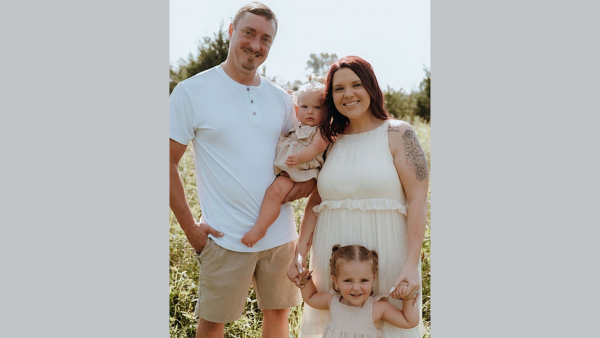
Before cancer, life at age 31 was everything Morgan Robertson had dreamed of. She was married to Brett, a husband who loved her fiercely and made her feel adored in the way she had once only hoped for.
Then motherhood changed her life completely. When Willow was born in 2022, she knew in those quiet early-morning hours holding her newborn daughter that being a mom was what she was meant to do. When Weslynn, “Wessie,” arrived in 2024, her heart grew even more.
Her days were full of ordinary blessings: working with a ‘second family’ of co-workers in the office at Tom Tepe Autocenter, and building a life with the family that she treasured. Brett, 35, is her “Mr. Fix It,” and a ‘girl dad’ who teaches Willow and Wessie they can do anything - even in princess dresses and plastic high heels.
Now, after a Stage IV Metastatic Pancreatic Neuroendocrine Cancer diagnosis in May, the young wife and mother is using her voice to share a message she hopes reaches anyone who has ever felt dismissed in a doctor’s office: trust your body, keep asking questions, and do not stop fighting for answers.
Pancreatic neuroendocrine tumors are rare - making up less than 5% of all pancreatic cancers. This cancer is also rare for those 55+ but even more rare for someone in her thirties. This rarity, combined with symptoms that are similar to other diagnoses, contributes to under- or misdiagnosis according to the Mayo Clinic.
For more than five years, Morgan knew something was wrong. Again and again, she was told it was stress and anxiety. Doctors could not find the source of her pain, and each time she felt dismissed.
There was a face rash no one could explain. There were ulcers covering her stomach. In 2018, after throwing up blood, she was told it was from too much ibuprofen. But the worst symptom came after Willow was born - severe back pain under her right shoulder blade that moved to the front of her body under her sternum. She says labor was nothing compared to it.
No pain medication helped. Muscle relaxers did nothing. She passed out, threw up uncontrollably, and felt like she was going crazy. But deep down, she knew her body. She knew this was not stress.
After years of advocating for herself, one doctor finally listened. He dug deeper. He became the starting force in saving her life.
On May 7, 2026, at 7 a.m., her world stopped. She was at work when the call came: stage 2 pancreatic cancer with neuroendocrine tumors. Everything went blurry. Co-workers held her. She was too young. She was a mom. She was a wife.
Suddenly it felt like a death sentence. Later that month, at Mayo Clinic in Rochester, the diagnosis became even heavier: Stage IV Pancreatic Neuroendocrine Tumor Cancer.
The physical pain had been terrible, but the emotional pain became the hardest part. She could not eat. She could not sleep. She felt like she could not breathe.
One night, through tears, she begged God to help her carry the weight. In that moment, she says she heard the Holy Spirit speak inside her: “Give it all to God. It’s too heavy for you to carry.” An unexplainable peace came over her. It was no longer hers to carry alone.
After the Mayo diagnosis, she and Brett and her parents returned to the hotel where her in-laws and girls were waiting. She tried to hide her heartbreak, locking herself in the bathroom until she could pull herself together.
Later that night, she lay beside Willow watching The Good Dinosaur. Willow wrapped her arms around her mom’s neck and said, “It’s all okay, Mommy.”
Somehow, four year old Willow felt her mother’s worry. In that moment, Morgan made a promise to her girls, her husband, and herself: cancer was not going to win.
Years from now, she wants her daughters to know they were the driving force behind her determination. She wants them to see that hard things can be faced, even when they are terrifying.
She wants them to remember their mom as a fighter - not superhuman, but a mother who made a promise to her daughters that it was all going to be okay.
Morgan says, “The person I was didn't survive the trauma of the diagnosis. But I'm changing. I'm becoming who I was meant to be.” She’s on a mission to reach others.
She wants every person reading her story, especially every young person who has been told they are too young for something serious, to hear this clearly: you know your body better than anyone else.
You live in it. You feel it. When your body rings alarm bells, do not tune them out because someone else cannot find the source right away.
Ask for the tests. Ask for the blood work. Demand the scans. Switch doctors if you have to. Do not stop fighting because you do not fit an age category or because someone calls it stress.
“Dig your heels in the ground and fight until you have answers,” she said. “ ‘No’ isn’t a valid answer when it comes to your life. Never stop advocating for yourself.”
 Aurora Man Identified as Victim of Fatal Motorcycle Crash
 Dearborn County Recycling Center’s Costume Swap Open for 17th Year
 Rep. Zimmerman: Governor Answers Lawmakers' Call to Provide Diesel Fuel Relief for Farmers
 State Sen. Maxwell: Protecting Hoosier Communities
 UPDATE: Downtown Lawrenceburg Road Paving Schedule Announced
 South Ripley Sweeps Aurora Farmers Fair King & Queen Contest